


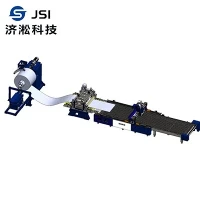


Integrated Loading and Unloading Transfer Press
Using robotic arms, servo transfer devices, and PLC control, it improves production efficiency and ensures stable operation.
Key Advantages: Fully automatic loading and unloading.
High transfer accuracy and stable performance.
Reduces labor costs and manual handling.
Improves production efficiency and safety.
Supports customized production solutions.
Applications: Automotive parts, home appliances, electrical equipment, and metal hardware manufacturing.
Products Description

An Integrated Loading & Unloading Transfer Press is an all-in-one system integrating multi-station stamping, automatic material handling and precision part transfer. It eliminates traditional stamping pain points: slow manual feeding, fluctuating throughput and positioning deviations.
Ideal for automotive body/chassis parts needing sequential forming and premium surface finish, plus home appliance sheet metal and medium-large hardware. The transfer unit synchronizes with the press and supports 2/3-axis motion. Most processes run unattended from blank destacking to part unloading. Built for real production, it delivers consistent operation and quick die change.
We offer a comprehensive service
Key Advantages
More stable production speed
When the transfer system works together with the press, waiting time drops clearly. Many users say the biggest improvement is the steady rhythm. Manual loading often causes speed changes; this system removes most of that problem.
Better positioning accuracy
Repeat positioning accuracy reaches about ±0.2 mm. This reduces part shift and surface scratches, which helps lower scrap rates.
Faster die and tool change
The system supports different end effectors such as vacuum cups, grippers, and magnets. Common recipes can be saved. Changing products usually takes less time than before.
Less need for operators
Destacking, centering, transfer, and unloading are mostly automatic. Workers mainly monitor the line and refill materials.
Reasonable space use
The integrated design takes less floor space than a press line with separate robots. Maintenance points are also more concentrated.
After-sales warranty service
All our products have warranty service.
technical parameters
Here are typical ranges. Final numbers depend on the part and production needs.
| Item | Typical Range | Selection Tip |
|---|---|---|
| Press force | 6,000 – 40,000 kN | Choose according to max part tonnage with some margin |
| Slide stroke | 400 – 900 mm | Prefer longer stroke for deep drawing parts |
| Strokes per minute | 10 – 70 spm | Servo drive gives more flexibility |
| Bolster size | Length 3,000 – 8,000 mm Width 1,200 – 2,750 mm |
Decide based on die layout and transfer stroke |
| Transfer axes | 2-axis or 3-axis | 3-axis recommended for complex or high-precision parts |
| Repeat positioning accuracy | ±0.2 mm | Stays reliable even at higher speeds |
| Control system | PLC + servo synchronization | Supports path programming and recipe storage |
When selecting a machine, first confirm part size, material thickness, and target speed. Then match the press force and transfer stroke. This avoids buying more capacity than needed.
Main Accessories
Press body: Closed-frame structure, slide, and drive system (mechanical, link, or servo options available)
Transfer system: Servo rails, clamping units, and feed mechanism
Loading and unloading units: Dual-station destacker, centering table, discharge belt or stacker
End effectors: Vacuum cups, pneumatic grippers, magnetic grippers (quick-change design)
End effectors: Vacuum cups, pneumatic grippers, magnetic grippers (quick-change design)
Common options: Moving bolster, quick die clamping, scrap conveyor, sound enclosure
All parts use a modular design. Factories can add or remove modules according to their existing line. Later upgrades and maintenance stay relatively simple.
FAQ
It is commonly used for automotive structure and chassis parts, home appliance sheet metal, and medium-to-large hardware stampings. It fits best when parts need several continuous forming steps and require stable speed plus good surface quality.
The transfer system is mounted directly on the press and runs in sync with the slide. This gives more stable speed and uses less floor space. Robots offer higher flexibility, but usually need more setup time and higher long-term maintenance cost. Many customers choose to add a transfer system to an existing press instead of replacing the whole line with robots.
Basic die change plus end-effector replacement usually takes 30 to 60 minutes with trained operators. With quick clamping and saved recipes, the time can be shorter.
Hot Tags: integrated loading and unloading transfer press, China integrated loading and unloading transfer press manufacturers, suppliers, factory, Independent Transfer System, transfer press, 3D Transfer System, Integrated Loading and Unloading Transfer Press, Multi Press Transfer System, Independent Manipulator
Previous
No InformationYou Might Also Like


Send Inquiry