


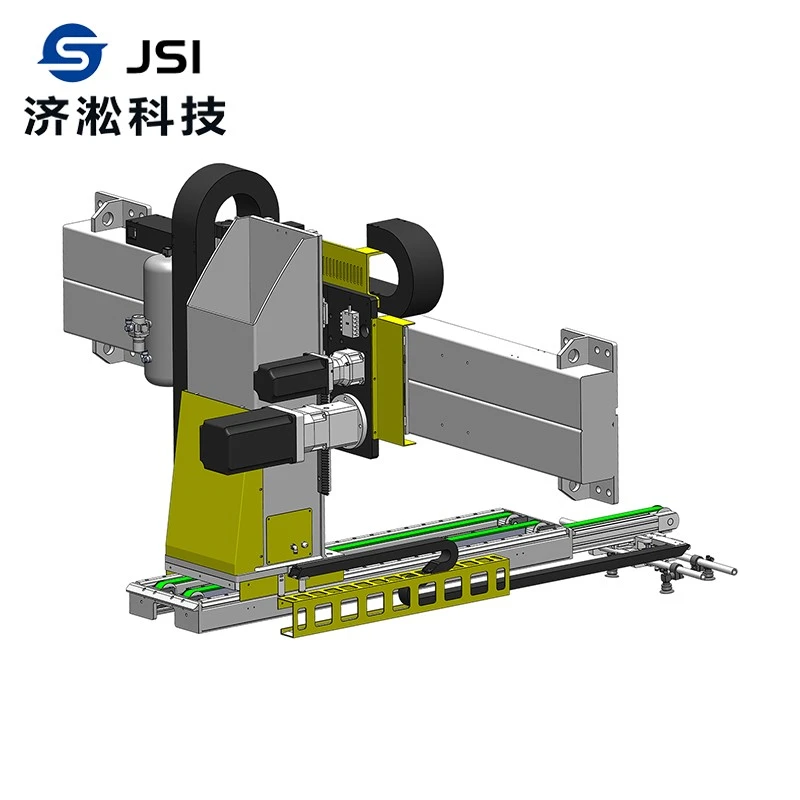


Multi Press Transfer System
The system supports automatic loading, transferring, positioning, and unloading. It can complete different stamping processes, such as punching, bending, drawing, and forming.
Key Advantages: Improves production efficiency. Reduces manual handling and labor costs. Provides accurate and stable workpiece transfer. Supports continuous automatic production. Improves product consistency.
Can be customized according to press layout, workpiece size, and production requirements. Applications: Automotive parts, home appliances, electrical cabinets, and metal components manufacturing.
Products Description

Description: Customized automated Multi Press Transfer System for the continuous production of 5 punches for the production of dishwasher accessories.
Introduction: The 5 machines connection includes: uncoiling - leveling - servo feeding - shear blanking - magnetic conveying (including rotary reversing table, positioning slap) - 5 punches with 6 sets of triple manipulators - discharge conveyor belt. Suitable for automatic production of household appliances and other accessories.
Features
features
Uncoiling, leveling, feeding, shearing, rotating, magnetic belt conveyor, stacking and unstacking, flapping positioning, triple speed manipulator grasp, discharging conveyor belt
Safety of the whole line up to TUV CE standard, safety door, safety lock and equipment linkage, open the door and power off.
The whole line total control, sub-control. Parameter one-key call, short mold change time
High production efficiency of the whole line, under the working condition of the press 5S, the whole line can reach 8.4S running speed.
Advantages
our services
Double speed machine with X, Y, Z three axes, Y axis direction can eliminate the whole line is not in a straight line problem
The double speed machine has only one clamp, which can quickly achieve large stroke transmission, and does not require a central station, saving space
The speed doubling machine has only one clamp, and the movement is flexible, without the mold height of each press
Speed doubling machine debugging does not need to stop the dead point after unified pressure, the impact on the power of the press is small
From the commissioning of the first machine, the time of each machine can be adjusted to the least waiting, so as to achieve efficient production
Responsibility
Efficient and precise processing and testing equipment.
Die Compatibility and Customization
A Multi Press Transfer System is designed to move workpieces between multiple stamping presses in a production line. To achieve smooth and reliable transfer, the system must match the press layout, stamping dies, workpiece shape, and production process.
Compatibility with Existing Stamping Dies
When planning a multi press transfer system, die compatibility is an important factor. The transfer mechanism needs enough space to pick up, move, and release each workpiece without interfering with the dies or press structures.
Before designing the system, the following information should be reviewed:
Die dimensions: The size and layout of each stamping die affect the available transfer space.
Press specifications: Press spacing, working height, table dimensions, and the arrangement of each press help determine the transfer layout.
Workpiece shape and weight: Part dimensions, weight, and surface features affect the choice of grippers and transfer methods.
Transfer path: The movement between presses must match the stamping sequence and the position of each workpiece.
Production requirements: Required cycle time, workpiece orientation, and the number of stamping stages influence the system design.
Customized Transfer Solutions
Every stamping line has different requirements. JS Tech can discuss a customized Multi Press Transfer System based on the customer's existing equipment and production needs.
Depending on the project, customization may include transfer structure, gripper design, movement range, press-to-press spacing, control functions, and safety arrangements.
For an existing production line, the design should consider the current press layout and die conditions. For a new stamping line, transfer equipment and press arrangements can be planned together to support smoother material movement.
To evaluate your project, please provide press specifications, die drawings, workpiece drawings or samples, the planned stamping sequence, and the available installation space. These details help determine a suitable transfer configuration.
Note: Final die compatibility and customization options must be confirmed through technical review before production.
How Does a Multi Press Transfer System Work?
Step 1: Workpiece Loading
A workpiece is placed into the first stamping station by the designated loading method. Depending on the production line, this may involve an operator, a loading robot, or another automated handling device.
Step 2: First Stamping Operation
The first press performs the required stamping operation according to the die design. After the press completes its cycle and the transfer conditions are met, the workpiece is ready to move to the next station.
Step 3: Automatic Workpiece Transfer
The transfer mechanism grips the workpiece and moves it from one press to the next along the configured transfer path. The movement sequence depends on the workpiece shape, die layout, and production requirements.
Step 4: Positioning at the Next Press
The workpiece is placed in the next die position. The system must release the workpiece correctly and allow the next stamping operation to begin under the configured control and safety conditions.
Step 5: Repeated Stamping and Transfer
The process continues through the required stamping stations. Each press performs its assigned operation, while the transfer system coordinates workpiece movement between stations.
Step 6: Finished Part Unloading
After the final stamping operation, the finished part is transferred to the designated unloading position or downstream handling equipment, depending on the production line configuration.
1. Can a Multi Press Transfer System work with my existing stamping presses and dies?
It may be possible, depending on your press specifications, die dimensions, press spacing, workpiece shape, and transfer requirements. Please provide your press layout and die drawings for a compatibility review.
2. Can the transfer system be customized for my production line?A customized solution can be discussed based on your stamping process, press arrangement, workpiece dimensions, required transfer path, and production targets. The final design depends on a technical review of your application.
3. Can I provide workpiece samples or drawings before ordering?
Workpiece drawings, photos, material details, and samples can help the engineering team understand your application. Please confirm sample delivery and any testing arrangements with our sales team before sending physical parts.
4. What is the minimum order quantity (MOQ) for a Multi Press Transfer System?
MOQ and order requirements depend on the project scope and equipment configuration. As this is an industrial automation system that may require project-specific engineering, please contact our sales team for confirmation.
Hot Tags: multi press transfer system, China multi press transfer system manufacturers, suppliers, factory, transfer press, Independent Transfer System, Multi Press Transfer System, Integrated Loading and Unloading Transfer Press, Independent Manipulator, 3D Transfer System
Previous
No InformationYou Might Also Like


Send Inquiry