


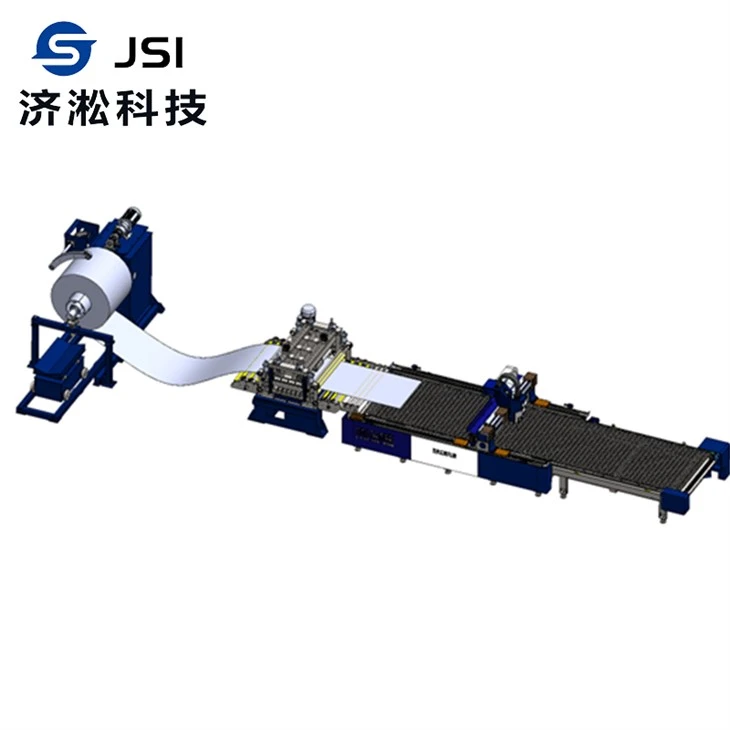


Laser Blanking Line
Features
Blanking With No Die Changes
Laser blanking lines are highly flexible and extremely productive manufacturing systems. We use high-performance fiber lasers for the continuous cutting of coil material. The result is extremely high productivity, excellent cutting quality and impressive contour accuracy-especially where delicate body shell blanks are involved.
Quality And Flexibility in A Single System
Dynamic Flow Technology makes it possible to cut different materials-including steel, aluminum, and high-strength steels-on a single production line. Even material combinations like steels for thermoformed components in bodywork structures are easily handled by our system.
Advantages
The Modular Concept
laser blanking lines deliver a modular design and excellent ease of use. Because the system is designed to be installed above-ground, it can also be used in normal logistics buildings. Special foundations, such as those required by presses, are therefore not necessary. The only thing left to do is supply the coils and cart off the stacks! They can be used to process steel and aluminum for body shell blanks as well as structural parts.
Maximum Contour Flexibility
Laser blanking is the digital way to cut blanks. Simply load a drawing and select the material: It's all the software needs in order to come up with a blanking program. The program is created offline in your office, giving you the ability to simulate various different scenarios to arrive at the optimal combination of material utilization and output. Of course, these part-specific programs can also be saved and modified at any time. The result is a high level of flexibility that significantly reduces development time for optimal blanks while also allowing needs-based production. This not only makes production planning easier, it also opens the door to continuous contour optimizations for the forming process. What's more: Laser cutting does not require any gap between individual parts-which is typically not the case where blanking dies are used. Combined with flexible nesting functions, this unlocks new potential for saving material.
Optimal material utilization
Laser blanking helps save material:
1. Conversion of rectangular and trapezoidal blanks into contoured blanks
The only reason to use rectangular or trapezoidal blanks for bodywork manufacturing in the automotive industry is because cut-to-length systems are readily available. It's a method that does not require expensive blanking dies. The drawback, however, is that truly optimal blanks are only obtained in the rarest of cases. Thanks to the programmable cut we offer, you can change a straight line into a sinusoidal or arched contour and thereby improve your material utilization rate or forming characteristics.
Contoured blanks from flatbed lasers
Blanks made by flatbed lasers are often used where aluminum blanks or smaller vehicle series are involved. Here, the starting material consists of metal sheets from which contoured blanks are cut. A continuous scrap grate is necessary to ensure that loading and unloading can proceed in an automated manner. Moving the production of these products to a laser cutting system makes it possible to use over 10% less material in most cases!
Dividing strips between blanks
Die-based cutting requires a dividing strip between the blanks. In laser cutting, on the other hand, both sides of the cut are considered good edges, meaning that a dividing strip is no longer needed. If the dividing strips amount to 1 cm of material over 1 m of feed length, we're already reducing material waste by 1%!
More than 90% of the blank value is accounted for by material. The total value of the material ejected out of a blanking line each year is enormous. Reducing the amount of scrap material can therefore save millions of euros.
Summary
- Direct-from-coil process
- Optimized nesting on the material line
- Conversion of rectangles and trapezoids into contoured blanks
- Elimination of dividing strips between blanks
- Combination of different parts on the material line
- Positioning of blanks at different angles
- Reduced variety of coils thanks to flexible nesting
Hot Tags: laser blanking line, China laser blanking line manufacturers, suppliers, factory, 3 in 1 Blanking Line, Laser Blanking Line, Zigzag feeding Line, Multi Cut Precison Blanking Line, blanking line, Zigzag Blanking Line
Previous
Zigzag Blanking LineYou Might Also Like


Send Inquiry