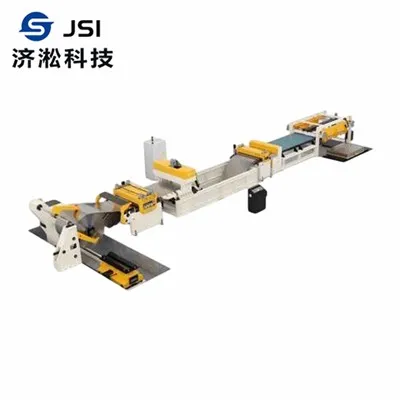
Hey there! As a supplier of High Speed Blanking Lines, I've been getting a lot of questions lately about the role of the buffer in these setups. So, I thought I'd take some time to break it down for you.
First off, let's talk about what a High Speed Blanking Line is. In simple terms, it's a piece of equipment used in the metalworking industry to cut metal sheets into specific shapes and sizes at high speeds. We offer different types of High Speed Blanking Lines, like the 3 in 1 Blanking Line, Multi Cut Precison Blanking Line, and Zigzag Blanking Line. Each of these has its own unique features and benefits, but they all rely on a buffer to function effectively.
So, what exactly is a buffer in a High Speed Blanking Line? Well, it's a device that stores a certain amount of material between different sections of the line. Think of it as a temporary storage area that helps to balance the flow of material through the line.
One of the main roles of the buffer is to compensate for differences in speed between different parts of the line. In a High Speed Blanking Line, different operations, such as feeding, cutting, and stacking, may have different optimal speeds. For example, the feeder might be able to supply material at a very high rate, but the cutting press may need to operate at a slightly slower pace to ensure accurate cuts. The buffer acts as a bridge between these two sections, allowing the feeder to keep working at its maximum speed while the press takes its time to make the cuts.
Let's say the feeder is supplying metal sheets at a rate of 100 sheets per minute, but the press can only handle 80 sheets per minute. Without a buffer, the feeder would have to slow down to match the press's speed, which would reduce the overall efficiency of the line. However, with a buffer in place, the feeder can continue to supply sheets at its full speed, and the excess sheets are stored in the buffer. The press can then draw sheets from the buffer at its own pace, ensuring that it always has a supply of material available without overloading.
Another important role of the buffer is to provide a buffer against any interruptions or fluctuations in the supply of material. In a real - world manufacturing environment, there can be many factors that cause disruptions, such as a jam in the feeder, a malfunction in the press, or a delay in the delivery of new coils of metal. When such an interruption occurs, the buffer can continue to supply material to the downstream sections of the line for a certain period of time.
For instance, if there's a brief jam in the feeder, the buffer can keep the press supplied with material until the jam is cleared. This means that the press doesn't have to stop completely, which can save a lot of time and reduce the number of incomplete or wasted parts.
The buffer also helps to improve the quality of the blanking process. By providing a stable supply of material, it reduces the chances of variations in the tension and alignment of the metal sheets. In a High Speed Blanking Line, even small variations in tension or alignment can lead to inaccurate cuts or damaged parts. The buffer ensures that the material entering the cutting press is in a consistent state, which results in higher - quality blanks.
In addition to these functions, the buffer can also be used to perform some pre - processing operations on the material. Some buffers are equipped with devices that can clean, lubricate, or measure the thickness of the metal sheets before they enter the cutting press. This helps to further improve the quality of the final product and can also reduce the wear and tear on the cutting tools.
Now, let's talk about the different types of buffers that are commonly used in High Speed Blanking Lines. There are several types, including loop buffers, accumulator buffers, and tower buffers.
Loop buffers are one of the most common types. They consist of a loop of material that is formed between two sets of rollers. As the material moves through the loop, it can expand or contract depending on the flow of material. Loop buffers are relatively simple and cost - effective, and they can handle a wide range of material thicknesses and widths.
Accumulator buffers, on the other hand, use a series of movable arms or belts to store the material. These buffers can store a larger amount of material compared to loop buffers and are often used in high - volume production lines.
Tower buffers are tall structures that use a vertical arrangement to store material. They are ideal for situations where floor space is limited, as they can store a large amount of material in a relatively small footprint.
When choosing a buffer for a High Speed Blanking Line, there are several factors to consider. The size of the buffer is an important consideration. It needs to be large enough to store an adequate amount of material to compensate for speed differences and interruptions, but not so large that it takes up too much space or becomes too expensive to operate.
The type of material being processed also matters. Different materials have different properties, such as stiffness, thickness, and surface finish, which can affect the performance of the buffer. For example, a buffer that is designed for thin, flexible materials may not work well for thick, rigid sheets.
The speed and capacity of the line are also crucial factors. A high - speed line with a large production volume will require a buffer with a higher storage capacity and a faster response time compared to a slower, lower - volume line.
In conclusion, the buffer plays a vital role in a High Speed Blanking Line. It helps to improve the efficiency, quality, and reliability of the blanking process by balancing the flow of material, compensating for speed differences, and providing a buffer against interruptions. Whether you're using a 3 in 1 Blanking Line, Multi Cut Precison Blanking Line, or Zigzag Blanking Line, a well - designed buffer is essential for getting the most out of your equipment.
If you're in the market for a High Speed Blanking Line or need to upgrade your existing line with a better buffer system, I'd love to have a chat with you. We have a team of experts who can help you choose the right equipment for your specific needs. Just reach out to us, and we'll be happy to start the conversation about how we can improve your manufacturing process.


References
- Manufacturing Handbook of High - Speed Blanking Technology
- Industry Reports on Metalworking Equipment and Processes