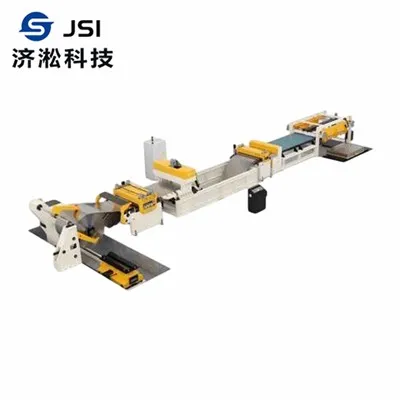
In the realm of metal processing, the Coil Cut To Length Line stands as a cornerstone of efficiency and precision. As a seasoned supplier of Coil Cut To Length Lines, I've witnessed firsthand the transformative power of this machinery in various industries. Among the many components that make up a Coil Cut To Length Line, the straightener plays a crucial yet often underappreciated role. In this blog post, I'll delve into the functions of the straightener in a Coil Cut To Length Line, shedding light on its significance and impact on the overall process.
Understanding the Coil Cut To Length Line
Before we explore the role of the straightener, let's briefly understand what a Coil Cut To Length Line is. A Coil Cut To Length Line is a specialized piece of equipment designed to process metal coils into flat sheets of a specific length. This process involves unwinding the coil, straightening the metal strip, measuring and cutting it to the desired length, and stacking the finished sheets. The entire process is automated, ensuring high precision and efficiency. You can learn more about Coil Cut To Length Line on our website.
The Importance of Straightening in Metal Processing
When metal is wound into a coil, it takes on a curved shape due to the tension and pressure applied during the coiling process. This curvature can cause significant problems during subsequent processing, such as uneven cutting, poor surface finish, and inaccurate dimensions. Straightening the metal strip is therefore essential to ensure that it meets the required quality standards and can be processed further without any issues.
Functions of the Straightener in a Coil Cut To Length Line
The straightener in a Coil Cut To Length Line performs several critical functions that are essential for the overall success of the metal processing operation. Let's take a closer look at each of these functions:
1. Eliminating Coil Set
Coil set refers to the residual curvature and stress that remains in the metal strip after it has been unwound from the coil. This can cause the strip to warp or twist, making it difficult to cut and process accurately. The straightener uses a series of rollers to apply pressure to the metal strip, gradually bending it in the opposite direction of the coil set. This helps to eliminate the residual curvature and stress, resulting in a flat and straight strip.
2. Correcting Camber
Camber is a common defect in metal strips that occurs when one edge of the strip is longer than the other. This can cause the strip to curve or bow, making it difficult to cut and process accurately. The straightener can correct camber by applying more pressure to the longer edge of the strip, gradually stretching it to match the length of the shorter edge. This helps to ensure that the strip is straight and flat, with no visible curvature or bowing.
3. Improving Surface Finish
The straightening process can also help to improve the surface finish of the metal strip. As the strip passes through the straightener, the rollers apply pressure to the surface of the strip, smoothing out any rough spots or imperfections. This helps to improve the overall appearance of the strip and makes it more suitable for subsequent processing, such as painting or coating.
4. Enhancing Dimensional Accuracy
In addition to eliminating coil set and correcting camber, the straightener can also help to enhance the dimensional accuracy of the metal strip. By applying precise pressure to the strip, the straightener can ensure that it has a consistent thickness and width throughout its length. This helps to ensure that the finished sheets have accurate dimensions and meet the required quality standards.
Types of Straighteners Used in Coil Cut To Length Lines
There are several types of straighteners that can be used in a Coil Cut To Length Line, each with its own unique features and advantages. The most common types of straighteners include:
1. Roller Straighteners
Roller straighteners are the most widely used type of straightener in Coil Cut To Length Lines. They consist of a series of rollers that are arranged in a staggered pattern. As the metal strip passes through the rollers, the rollers apply pressure to the strip, gradually bending it in the opposite direction of the coil set. Roller straighteners are available in a variety of configurations, including two-high, three-high, and multi-high designs.
2. Leveling Machines
Leveling machines are another type of straightener that can be used in a Coil Cut To Length Line. They are similar to roller straighteners, but they use a different method of applying pressure to the metal strip. Instead of using rollers, leveling machines use a series of adjustable blades that are arranged in a horizontal plane. As the metal strip passes through the blades, the blades apply pressure to the strip, gradually flattening it out. Leveling machines are typically used for thicker and heavier metal strips.


3. Tension Levelers
Tension levelers are a specialized type of straightener that is used to straighten thin and lightweight metal strips. They work by applying tension to the metal strip as it passes through a series of rollers. This helps to stretch the strip and eliminate any residual curvature or stress. Tension levelers are typically used for applications where high precision and surface finish are required, such as in the automotive and electronics industries.
Factors to Consider When Choosing a Straightener
When choosing a straightener for a Coil Cut To Length Line, there are several factors that need to be considered. These include:
1. Material Type and Thickness
The type and thickness of the metal strip that will be processed will determine the type of straightener that is required. For example, thinner and lighter metal strips may require a tension leveler, while thicker and heavier metal strips may require a roller straightener or a leveling machine.
2. Production Volume
The production volume of the Coil Cut To Length Line will also affect the choice of straightener. For high-volume production, a more robust and efficient straightener may be required. On the other hand, for low-volume production, a simpler and more cost-effective straightener may be sufficient.
3. Precision Requirements
The precision requirements of the finished sheets will also play a role in the choice of straightener. For applications where high precision is required, a straightener with advanced features and controls may be necessary.
4. Budget
Finally, the budget for the Coil Cut To Length Line will also need to be considered when choosing a straightener. Straighteners can vary significantly in price, depending on their type, size, and features. It's important to choose a straightener that meets the requirements of the application while also staying within the budget.
Conclusion
In conclusion, the straightener is a critical component of a Coil Cut To Length Line. It plays a crucial role in eliminating coil set, correcting camber, improving surface finish, and enhancing dimensional accuracy. By choosing the right straightener for your application, you can ensure that your Coil Cut To Length Line operates efficiently and produces high-quality finished sheets.
If you're in the market for a Coil Cut To Length Line or need to upgrade your existing equipment, we're here to help. As a leading supplier of Coil Cut To Length Lines, we offer a wide range of high-quality straighteners and other components to meet your specific needs. Contact us today to learn more about our products and services and to discuss your requirements with one of our experts.
References
- ASM Handbook, Volume 14A: Metalworking: Bulk Forming, ASM International, 2013.
- Metal Forming Handbook: Processes and Applications, Carl Hanser Verlag, 2008.
- Handbook of Metal Forming, CRC Press, 2008.