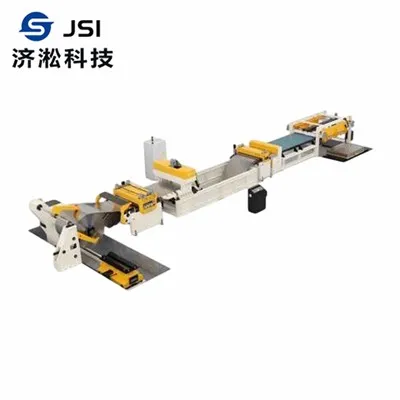
Hey there! As a supplier of precision levelers, I've seen firsthand how these machines play a crucial role in various industries. In this blog, I'm gonna break down how a precision leveler ensures consistent leveling quality.
First off, let's understand what a precision leveler is. It's a machine designed to flatten and straighten materials like metal sheets, strips, and coils. Whether you're in the automotive, aerospace, or manufacturing sector, having a flat and straight material is essential for the quality of your end product.
The Basics of Precision Leveling
At its core, a precision leveler works by passing the material through a series of rollers. These rollers apply pressure to the material, bending it back and forth to remove any internal stresses and irregularities. But it's not as simple as just running the material through the rollers. There are several factors that contribute to consistent leveling quality.
Roller Design and Configuration
The design and configuration of the rollers are key to achieving consistent leveling. The rollers need to be precisely machined to ensure uniform pressure distribution across the material. For example, our 4-layer High Precision Roller Leveler uses a multi-layer roller design that allows for more precise control over the leveling process. The different layers of rollers can be adjusted independently to accommodate different material thicknesses and leveling requirements.
The diameter and hardness of the rollers also play a role. Larger diameter rollers can provide more support and distribute pressure more evenly, while harder rollers can withstand higher pressures without deforming. We carefully select the roller materials and dimensions based on the specific application to ensure optimal performance.
Pressure Control
Another important factor is pressure control. The amount of pressure applied to the material needs to be carefully calibrated to achieve the desired leveling effect. Too much pressure can cause the material to be over-bent or damaged, while too little pressure may not be enough to remove the internal stresses.
Modern precision levelers are equipped with advanced pressure control systems. These systems use sensors to measure the pressure applied to the material and adjust it in real-time. This ensures that the pressure remains consistent throughout the leveling process, regardless of variations in the material thickness or hardness. Our Precision Leveler Machine features a state-of-the-art pressure control system that provides accurate and reliable pressure adjustment.
Speed and Feed Rate
The speed at which the material passes through the leveler and the feed rate also affect the leveling quality. If the speed is too fast, the rollers may not have enough time to properly bend the material, resulting in uneven leveling. On the other hand, if the speed is too slow, it can reduce productivity.
The feed rate, which is the rate at which the material is fed into the leveler, needs to be synchronized with the speed of the rollers. This ensures that the material is evenly distributed across the rollers and that the leveling process is consistent. Our precision levelers are designed to allow for easy adjustment of the speed and feed rate, so you can optimize the leveling process for your specific application.
Advanced Technologies for Consistent Leveling
In addition to the basic design and control features, modern precision levelers also incorporate advanced technologies to further improve the leveling quality.
Automated Measurement and Feedback
Some precision levelers are equipped with automated measurement systems that can detect the flatness and straightness of the material in real-time. These systems use sensors such as laser scanners or optical cameras to measure the surface profile of the material. The data collected by these sensors is then analyzed by a computer, which can adjust the leveling parameters accordingly.
This automated measurement and feedback system allows for continuous improvement of the leveling process. If the system detects any deviations from the desired flatness or straightness, it can automatically make adjustments to the pressure, speed, or roller position to correct the problem. This ensures that the leveling quality remains consistent throughout the production run.
Material Tracking and Sorting
Another advanced technology is material tracking and sorting. This feature allows the leveler to identify different types of materials and adjust the leveling parameters accordingly. For example, if you're leveling a batch of materials with different thicknesses or hardnesses, the leveler can automatically adjust the pressure and speed for each individual piece.
Material tracking and sorting can also help to improve the efficiency of the leveling process. By sorting the materials based on their characteristics, you can reduce the time spent on adjusting the leveling parameters between different batches of materials.
Quality Assurance and Maintenance
To ensure consistent leveling quality, it's also important to have a proper quality assurance and maintenance program in place.
Regular Inspections and Calibrations
Regular inspections and calibrations of the precision leveler are essential to ensure that it's operating at its optimal performance. This includes checking the roller alignment, pressure sensors, and other critical components. Any worn or damaged parts should be replaced immediately to prevent any negative impact on the leveling quality.
Calibration of the leveler is also important to ensure that the leveling parameters are accurate. This involves comparing the actual leveling results with the desired specifications and making any necessary adjustments. We recommend that you have your precision leveler calibrated at least once a year by a qualified technician.
Operator Training
Proper operator training is also crucial for achieving consistent leveling quality. Operators need to understand how to operate the leveler correctly, including how to adjust the pressure, speed, and roller position. They also need to be aware of the importance of quality control and how to identify any potential problems with the leveling process.


We provide comprehensive operator training programs for our customers to ensure that they can get the most out of our precision levelers. Our training programs cover everything from basic operation to advanced troubleshooting techniques.
Conclusion
In conclusion, a precision leveler ensures consistent leveling quality through a combination of advanced design, precise control systems, and advanced technologies. By carefully selecting the roller design and configuration, controlling the pressure and speed, and incorporating automated measurement and feedback systems, you can achieve a high level of flatness and straightness in your materials.
If you're in the market for a precision leveler, we invite you to check out our Sheet Material Precision Leveling Machine. Our machines are designed to provide the highest level of leveling quality and reliability. If you have any questions or would like to discuss your specific leveling requirements, please don't hesitate to contact us. We're here to help you find the best solution for your needs.
References
- "Precision Metal Forming Handbook" by Peter Groche
- "Roller Leveling Technology" by Industrial Press Inc.
- "Advanced Manufacturing Technologies for Metal Forming" by Springer