

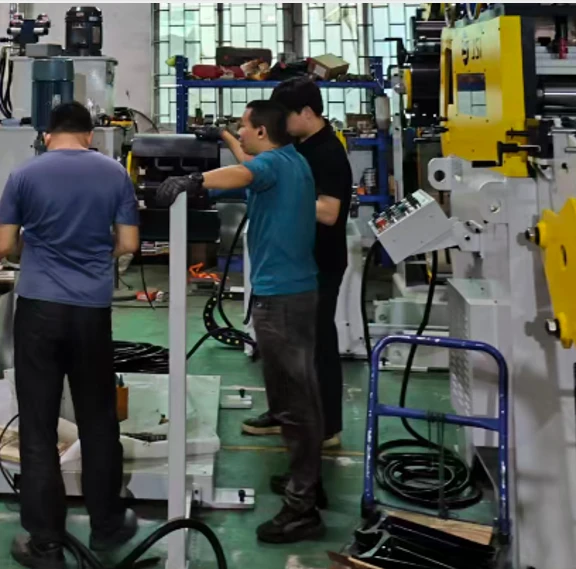
On the shop floor of a southern China automation equipment facility, three technicians huddle around a newly assembled production line, fine-tuning control panels and hydraulic feed systems before the unit ships to an overseas customer. The scene is increasingly common as global manufacturers accelerate factory automation to offset labor shortages and boost throughput.
The machine in frame represents a growing category of integrated stamping and feeding automation lines - a workhorse of metal forming, automotive component, and home appliance manufacturing. Equipped with programmable control panels, servo-driven feed mechanisms, and interlocked safety guarding (the bright yellow enclosure on the right), these systems allow a single operator to manage what once required a crew of several.
"Demand has been strongest from Southeast Asia and Eastern Europe," said a line supervisor at the facility, who asked not to be named. "Customers used to buy standalone presses. Now they ask for the whole line - decoiler, straightener, feeder, and press - connected and ready to run."
Industry tailwinds
Several forces are converging behind the sector:
Labor shortage pressures. Aging workforces in manufacturing heartlands are pushing small and mid-sized factories toward automation, even where capital budgets were historically tight.
Servo and motion-control adoption. Modern feeding lines are moving from pneumatic to fully servo-driven actuation, improving precision and reducing scrap.
Reshoring and nearshoring. Western electronics and automotive brands are diversifying supply chains, creating orders for turnkey production equipment.
Chinese automation equipment makers have historically competed on cost, but the floor scene shows a shifting focus: the technicians' hands-on commissioning, cable management, and painted guarding all point toward a push on quality, safety compliance, and after-sales support.
What customers now expect
Buyers increasingly want equipment that is not only reliable out of the crate, but also:
CE-certified safety systems for European markets;
IoT-ready controllers that can feed production data into MES platforms;
English-language HMI interfaces and remote-diagnostic capability;
Localized spare-parts stock to minimize downtime.
"Five years ago, price was the deciding factor," the supervisor said. "Now customers compare our control panel layout, our wiring, our manual. They want a machine their own engineers can service."
Outlook
Analysts expect global industrial automation equipment demand to keep a mid-single-digit growth trajectory through 2027, with press-automation and coil-feeding lines among the steadier sub-segments. For manufacturers in China's Pearl River Delta - long the workshop of the world - the bet is clear: move from building cheaper machines to building smarter, export-ready ones.
Back on the floor, the technicians wrap up their checks, run a short test cycle, and the line hums to life. In a few weeks it will be uncrated thousands of miles away, where it will run three shifts a day and, in effect, quietly demonstrate why the automation boom is far from over.


