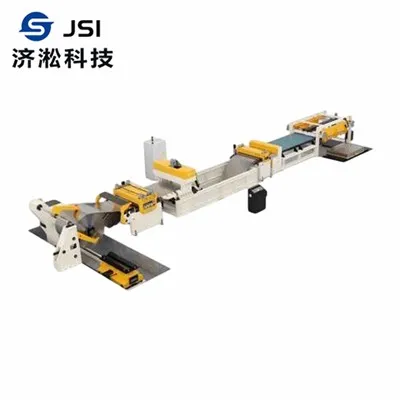
Hey there! As a supplier of cut to length lines, I'm super stoked to break down the working principle of these awesome machines. A cut to length line is a key piece of equipment in the metal processing industry, used to cut metal coils into sheets of specific lengths. It's a process that combines precision, speed, and efficiency, and I'm here to walk you through how it all works.


The Basics of a Cut to Length Line
First off, let's understand the main components of a cut to length line. There are typically four main parts: the decoiler, the leveler, the shear, and the stacker. Each part plays a crucial role in the overall operation of the line.
The decoiler is where it all starts. It holds the metal coil and slowly unwinds it. This process needs to be smooth and controlled to ensure that the metal strip feeds evenly into the next stage. Think of it like unrolling a giant roll of tape, but instead of tape, it's a heavy - duty metal coil.
Once the metal strip is unwound, it goes into the leveler. The leveler is responsible for flattening the strip. Metal coils often have some curvature or unevenness due to the coiling process, and the leveler straightens it out. It uses a series of rollers that apply pressure to the strip from different angles, gradually removing any bends or waves.
After the strip is leveled, it reaches the shear. The shear is the heart of the cut to length line. This is where the strip is cut into sheets of the desired length. There are different types of shears, but the most common ones are hydraulic shears. You can check out a Hydraulic Metal Sheet Shearing Machine for more details on how these work. The shear uses a sharp blade that comes down with great force to make a clean cut through the metal.
Finally, the cut sheets are moved to the stacker. The stacker neatly arranges the sheets into a stack, ready for further processing or shipping. It's important that the sheets are stacked properly to avoid any damage during handling.
The Working Process in Detail
Let's dive deeper into how the cut to length line operates step - by - step.
Step 1: Loading the Coil
The first step is to load the metal coil onto the decoiler. This can be a heavy and tricky task, often requiring some form of lifting equipment like a crane. Once the coil is securely on the decoiler, the operator sets the initial parameters, such as the coil diameter and width.
Step 2: Unwinding
The decoiler starts to unwind the coil. The speed of unwinding is carefully controlled to match the speed of the rest of the line. If the unwinding is too fast, it can cause the strip to bunch up or get damaged. If it's too slow, it can slow down the entire production process.
Step 3: Leveling
As the strip enters the leveler, the rollers start to work their magic. The operator can adjust the pressure and the position of the rollers depending on the thickness and material of the metal. For example, thicker metals may require more pressure to be properly flattened.
Step 4: Measuring and Cutting
Before the shear makes a cut, the length of the strip needs to be measured. This is usually done using a measuring device, such as an encoder. The encoder counts the number of rotations of a roller and calculates the length of the strip based on the roller's circumference. Once the desired length is reached, a signal is sent to the shear to make the cut.
The shear then activates, and the blade comes down quickly to cut the strip. The entire process is very precise, and modern cut to length lines can achieve a high level of accuracy in cutting lengths.
Step 5: Stacking
After the sheet is cut, it is transferred to the stacker. The stacker has a conveyor system that moves the sheet to the stacking area. Here, the sheets are stacked one on top of the other in an orderly manner. Some stackers can also perform additional functions, such as weighing the stack or wrapping it for protection.
Different Types of Cut to Length Lines
There are various types of cut to length lines available, each designed for different applications and materials.
Multi - function Cutting Line
A Multi - function Cutting Line is a versatile option. It can handle different types of metals, such as steel, aluminum, and copper. It also has additional features, like the ability to cut at different angles or perform notching operations. This makes it suitable for a wide range of industries, from automotive to construction.
High - Speed Steel Cut To Length Machine Line
For high - volume production, a High Speed Steel Cut To Length Machine Line is the way to go. These lines are designed to operate at very high speeds, cutting steel sheets with great efficiency. They are often used in large - scale manufacturing plants where speed and productivity are key.
Advantages of Using a Cut to Length Line
Using a cut to length line offers several advantages. Firstly, it improves efficiency. Instead of manually cutting metal sheets, which is time - consuming and less accurate, a cut to length line can cut sheets at a much faster rate with high precision.
Secondly, it reduces waste. Since the cutting process is so accurate, there is less scrap material generated. This not only saves on material costs but also has a positive impact on the environment.
Thirdly, it enhances the quality of the cut sheets. The leveler ensures that the sheets are flat, and the shear makes clean cuts, resulting in high - quality finished products.
Why Choose Our Cut to Length Lines
As a supplier, we take pride in offering top - notch cut to length lines. Our lines are built with high - quality components, ensuring long - term reliability and performance. We also provide excellent after - sales service, including maintenance and technical support.
Our team of experts can help you choose the right cut to length line for your specific needs. Whether you're a small - scale workshop or a large manufacturing plant, we have a solution for you.
If you're in the market for a cut to length line, don't hesitate to reach out. We're always happy to have a chat about your requirements and see how we can help you improve your metal processing operations. Contact us today to start the conversation and explore the possibilities of our cut to length lines.
References
- Metal Processing Handbook
- Industry reports on cut to length line technology