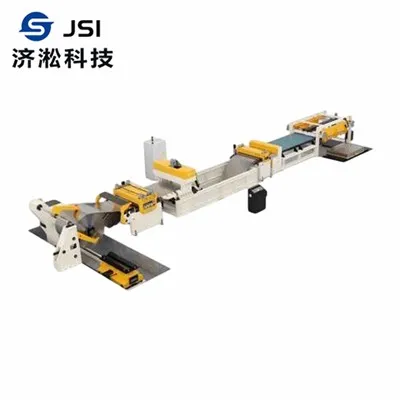
Hey there! As a supplier of Precision Leveler Machines, I often get asked about the leveling process control method for these nifty pieces of equipment. So, I thought I'd sit down and share some insights on what it is and how it works.
First off, let's talk about what a Precision Leveler Machine is. It's a specialized piece of machinery used to flatten and straighten various materials, such as metal sheets, coils, and strips. These machines are crucial in industries like automotive, aerospace, and manufacturing, where precision and quality are top priorities.
Now, the leveling process control method is all about ensuring that the material being leveled meets the required specifications. There are several key aspects to this process, and I'll break them down for you.
Understanding the Material
The first step in the leveling process control is to understand the material you're working with. Different materials have different properties, such as hardness, thickness, and elasticity. These properties can greatly affect the leveling process, so it's important to know what you're dealing with.
For example, if you're leveling a thin, soft metal sheet, you'll need to use a different approach than if you're leveling a thick, hard metal coil. The leveler machine needs to be adjusted accordingly to ensure that the material is flattened and straightened without causing any damage.
Setting the Leveler Machine
Once you understand the material, the next step is to set up the leveler machine. This involves adjusting the various parameters of the machine, such as the roller gap, roller speed, and pressure. These settings will depend on the type and thickness of the material, as well as the desired level of flatness and straightness.
Most modern Precision Leveler Machines come with advanced control systems that allow you to set these parameters accurately. Some machines even have automated features that can adjust the settings based on the material properties and the leveling requirements.
Monitoring the Leveling Process
During the leveling process, it's important to monitor the material to ensure that it's being leveled correctly. This can be done using various sensors and measuring devices, such as laser sensors, strain gauges, and thickness gauges.
These sensors can provide real-time feedback on the flatness and straightness of the material, as well as any other relevant parameters. If the material is not being leveled correctly, the control system can automatically adjust the machine settings to correct the problem.
Quality Control
Once the leveling process is complete, the final step is to perform a quality control check on the material. This involves inspecting the material for any defects, such as scratches, dents, or unevenness.
If the material meets the required specifications, it can be used in the production process. If not, it may need to be re-leveled or discarded.
Types of Leveling Process Control Methods
There are several different types of leveling process control methods, each with its own advantages and disadvantages. Here are some of the most common methods:
Closed-Loop Control
Closed-loop control is a popular method that uses feedback from sensors to adjust the machine settings in real-time. This method is very accurate and can ensure that the material is leveled to a high degree of precision.
However, closed-loop control systems can be complex and expensive to implement. They also require regular maintenance and calibration to ensure that they are working correctly.


Open-Loop Control
Open-loop control is a simpler method that does not use feedback from sensors. Instead, the machine settings are pre-programmed based on the material properties and the leveling requirements.
This method is less accurate than closed-loop control, but it is also less expensive and easier to implement. Open-loop control systems are often used for applications where a high degree of precision is not required.
Manual Control
Manual control is the most basic method of leveling process control. It involves adjusting the machine settings manually based on the operator's experience and judgment.
This method is the least accurate and most labor-intensive, but it is also the most flexible. Manual control is often used for small-scale production or for applications where the material properties and leveling requirements are not well-defined.
Conclusion
In conclusion, the leveling process control method for a Precision Leveler Machine is a crucial aspect of ensuring that the material is flattened and straightened to the required specifications. By understanding the material, setting up the machine correctly, monitoring the leveling process, and performing a quality control check, you can ensure that the material meets the highest standards of quality and precision.
If you're in the market for a Precision Leveler Machine, I encourage you to check out our Coil Material Precision Leveling Machine, Precision Leveler Machine, and 4-layer High Precision Roller Leveler. These machines are designed to provide the highest level of performance and reliability, and they come with advanced control systems that make the leveling process easy and efficient.
If you have any questions or would like to learn more about our Precision Leveler Machines, please don't hesitate to contact us. We'd be happy to help you find the right machine for your needs and provide you with all the information you need to make an informed decision.
References
- "Precision Leveling of Metal Sheets and Coils," Industrial Machinery Handbook, 2023.
- "Advanced Control Systems for Leveling Machines," Journal of Manufacturing Technology, Vol. 15, No. 3, 2022.
- "Quality Control in the Leveling Process," Manufacturing Engineering Magazine, April 2023.