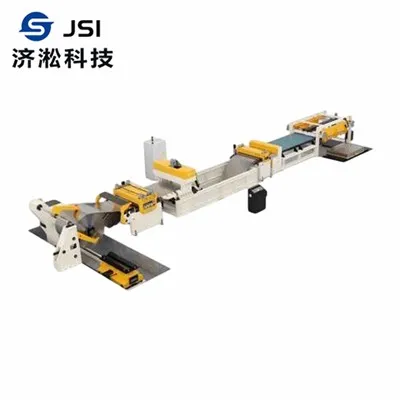
Hey there! As a supplier of thin sheet straighteners, I've seen firsthand how these nifty machines can really shake things up when it comes to the mechanical properties of thin sheets. So, let's dive right in and talk about how a thin sheet straightener affects those properties.
First off, what exactly is a thin sheet straightener? Well, it's a machine designed to remove any unwanted curves, bends, or waves from thin metal sheets. You know, those sheets that are used in all sorts of industries, from automotive to aerospace, and even in everyday items like appliances. There are different types of thin sheet straighteners out there, like the S Type Straightener, the Straightener - top Flip Up, and the Middle Sheet Straightener. Each type has its own unique features and benefits, but they all share the common goal of making those thin sheets nice and straight.
Now, let's get into how a thin sheet straightener affects the mechanical properties of the sheets. One of the most obvious effects is on the flatness of the sheet. When a sheet is bent or curved, it can cause stress concentrations in certain areas. These stress concentrations can weaken the sheet and make it more prone to cracking or breaking under load. By using a thin sheet straightener to remove those bends and curves, we can distribute the stress more evenly across the sheet. This results in a more uniform stress distribution, which in turn improves the overall strength and durability of the sheet.
For example, let's say you have a thin steel sheet that's been coiled during the manufacturing process. When you uncoil it, you'll likely find that it has some residual curvature. If you try to use this curved sheet in a high - stress application, like in the frame of a car, those stress concentrations could lead to premature failure. But if you run the sheet through a thin sheet straightener, it'll come out nice and flat. The steel will be able to withstand more force without deforming or breaking, making it a much better candidate for that car frame.
Another important mechanical property that's affected is the surface quality of the sheet. During the straightening process, the rollers in the straightener come into contact with the sheet. These rollers apply pressure to the sheet to flatten it out. If the rollers are properly designed and maintained, they can also smooth out any rough spots or surface irregularities on the sheet. This improved surface quality can have a big impact on how the sheet performs in different applications.
For instance, in the electronics industry, thin metal sheets are often used as components in circuit boards. A smooth surface is crucial for proper electrical conductivity and for ensuring a good connection between different parts of the circuit. If the sheet has rough spots or bumps, it can interfere with the flow of electricity and cause malfunctions. A thin sheet straightener can help to create a smooth, uniform surface, which is essential for the reliable operation of these electronic components.
The straightening process can also affect the hardness of the thin sheet. When the sheet is deformed during straightening, it undergoes plastic deformation. Plastic deformation is a process where the material is permanently changed in shape. This plastic deformation can cause work - hardening in the sheet. Work - hardening is when the material becomes harder and stronger as a result of being deformed.


However, it's important to note that too much work - hardening can also have negative effects. If the sheet is over - straightened, it can become too hard and brittle. A brittle sheet is more likely to crack or shatter under impact. So, as a supplier, we need to carefully control the straightening process to achieve the right balance between work - hardening and maintaining the ductility of the sheet. Ductility is the ability of the material to be stretched or deformed without breaking.
In addition to flatness, surface quality, and hardness, a thin sheet straightener can also affect the anisotropy of the sheet. Anisotropy refers to the difference in mechanical properties depending on the direction in the material. In many cases, thin sheets can have anisotropic properties due to the manufacturing process, such as rolling. When a sheet is rolled, the grains in the metal tend to align in a certain direction, which can cause the sheet to have different strengths and ductilities in different directions.
A thin sheet straightener can help to reduce this anisotropy. By applying pressure in multiple directions during the straightening process, the straightener can realign the grains in the metal. This realignment can make the mechanical properties of the sheet more consistent in all directions. For example, in a sheet that's used for stamping operations, having more isotropic (uniform) properties is beneficial. It allows the sheet to be stamped into different shapes more easily, without the risk of tearing or cracking due to differences in strength in different directions.
Now, let's talk about some of the factors that can influence how a thin sheet straightener affects the mechanical properties. One of the key factors is the type of material being straightened. Different materials, such as aluminum, copper, and stainless steel, have different mechanical properties to begin with. For example, aluminum is a relatively soft and ductile material, while stainless steel is harder and more resistant to corrosion. The straightening process needs to be adjusted depending on the material. For a soft material like aluminum, we may need to use lower pressure and a different roller configuration compared to a harder material like stainless steel.
The thickness of the sheet is another important factor. Thicker sheets generally require more force to straighten compared to thinner sheets. If we apply too much force to a thin sheet, it can cause excessive deformation or even damage the sheet. On the other hand, if we don't apply enough force to a thick sheet, it won't be properly straightened. So, we need to carefully select the right straightening parameters, such as the roller pressure, speed, and number of passes, based on the thickness of the sheet.
The design and quality of the thin sheet straightener itself also play a crucial role. A well - designed straightener with high - quality rollers and a precise control system can provide more accurate and consistent straightening results. For example, a straightener with adjustable rollers can be fine - tuned to accommodate different sheet thicknesses and materials. This allows for a more customized straightening process, which can better preserve and enhance the mechanical properties of the sheet.
As a supplier of thin sheet straighteners, we understand the importance of providing our customers with the right equipment for their specific needs. Whether you're in the automotive, aerospace, electronics, or any other industry that uses thin metal sheets, we have the expertise and the products to help you achieve the best possible mechanical properties for your sheets.
If you're interested in learning more about how our thin sheet straighteners can benefit your business, or if you have any questions about the straightening process and its effects on the mechanical properties of your sheets, don't hesitate to reach out. We're here to assist you in finding the perfect solution for your thin sheet straightening needs. Whether you need a S Type Straightener, a Straightener - top Flip Up, or a Middle Sheet Straightener, we've got you covered. Let's work together to take your thin sheet applications to the next level!
References
- "Mechanical Metallurgy" by George E. Dieter. This book provides in - depth knowledge about the mechanical properties of metals and how they are affected by different manufacturing processes, including straightening.
- "Metal Forming: Mechanics and Metallurgy" by Srinivasa R. Kalpakjian and Steven R. Schmid. It offers valuable insights into the plastic deformation and work - hardening processes that occur during sheet straightening.