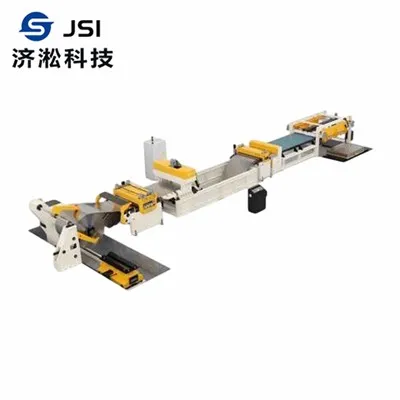
In the manufacturing and metalworking industries, material deformation is a common issue that can significantly impact the quality and usability of products. Large - scale material deformation, in particular, poses a substantial challenge. As a precision leveler supplier, I often encounter questions from clients regarding the ability of our precision levelers to correct such large - scale deformations. In this blog post, I will delve into this topic, exploring the capabilities of precision levelers in dealing with large - scale material deformation.
Understanding Large - Scale Material Deformation
Large - scale material deformation can occur due to various factors. During the manufacturing process, factors such as uneven cooling, excessive stress during forming, or improper handling can lead to significant warping, bending, or twisting of materials. For example, in the production of large metal sheets, uneven cooling rates can cause internal stresses to build up, resulting in the sheet taking on a non - planar shape. In the case of long metal bars, improper handling during transportation or storage can lead to bending along their length.
These deformations are not only aesthetically unappealing but also have a direct impact on the functionality of the final product. A deformed metal sheet may not fit properly into a manufacturing assembly, leading to production delays and increased costs. In applications where precision is crucial, such as in the aerospace or automotive industries, even minor deformations can compromise the performance and safety of the end - product.
How Precision Levelers Work
Precision levelers are machines designed to correct the flatness and straightness of materials. They operate on the principle of applying a series of precisely calculated forces to the deformed material. The basic components of a precision leveler typically include a set of upper and lower rollers. These rollers are arranged in a specific pattern, and their positions and pressures can be adjusted according to the characteristics of the material being leveled.
When a deformed material passes through the precision leveler, the rollers apply a combination of bending and straightening forces. The material is subjected to multiple cycles of bending in opposite directions, which helps to redistribute the internal stresses within the material. As the material moves through the leveler, the cumulative effect of these forces gradually reduces the deformation, bringing the material closer to its desired flat or straight state.
There are different types of precision levelers available, each suited to different materials and deformation levels. For instance, the Sheet Material Precision Leveling Machine is specifically designed for leveling metal sheets. It can handle a wide range of sheet thicknesses and widths, and its advanced control systems allow for precise adjustment of the leveling process. On the other hand, the High Precision Roller Leveler is capable of providing high - precision leveling for various materials, including strips and bars.
Can Precision Levelers Correct Large - Scale Deformation?
The answer to whether a precision leveler can correct large - scale material deformation is not a simple yes or no. It depends on several factors, including the type of material, the degree of deformation, and the capabilities of the specific precision leveler.
Material Type
Different materials have different mechanical properties, which affect their response to the leveling process. For example, soft metals like aluminum are generally more malleable and easier to level compared to harder metals like stainless steel. Aluminum can often tolerate larger amounts of bending and straightening without cracking or breaking, making it more suitable for correction of large - scale deformations using precision levelers.
On the other hand, harder materials may require more powerful precision levelers with higher force - applying capabilities. Additionally, some materials may have a tendency to work - harden during the leveling process, which can limit the extent to which they can be deformed without damage.
Degree of Deformation
The severity of the deformation plays a crucial role in determining the effectiveness of the leveling process. In general, precision levelers are more effective at correcting small to moderate deformations. For large - scale deformations, the leveler may need to apply a significant amount of force over an extended period. However, there are limits to the amount of force that can be applied without causing damage to the material.
If the deformation is too extreme, such as a severely twisted or bent bar, the precision leveler may not be able to fully correct it in a single pass. In some cases, multiple passes through the leveler may be required, or additional pre - treatment steps may be necessary to reduce the initial deformation to a level that the leveler can handle more effectively.
Capabilities of the Precision Leveler
The design and specifications of the precision leveler also determine its ability to correct large - scale deformation. High - end precision levelers, such as the Precision Leveler Machine, are equipped with advanced features that enhance their leveling capabilities. These may include adjustable roller positions, precise pressure control systems, and high - torque motors.
A precision leveler with a larger number of rollers can apply a more uniform and distributed force to the material, which is beneficial for correcting large - scale deformations. Additionally, levelers with advanced control systems can adapt to the changing characteristics of the material during the leveling process, ensuring a more accurate and effective correction.
Case Studies
To illustrate the effectiveness of precision levelers in correcting large - scale material deformation, let's consider a few case studies.
In a metal fabrication shop, a large batch of steel sheets had been deformed during storage. The sheets had significant warping, with some areas deviating from the desired flatness by up to several millimeters. The shop decided to use our Sheet Material Precision Leveling Machine. After a series of adjustments to the roller positions and pressures, the sheets were passed through the leveler. After multiple passes, the majority of the sheets were brought within an acceptable flatness tolerance, which was crucial for their use in a subsequent manufacturing process.
In another case, an automotive parts manufacturer had a problem with deformed metal bars. The bars were used in a critical engine component, and even minor deformations could affect the performance of the engine. The manufacturer used our High Precision Roller Leveler. By carefully calibrating the leveler according to the material properties and the degree of deformation, the manufacturer was able to correct the bars to the required straightness, ensuring the quality and reliability of the engine components.
Conclusion
In conclusion, while precision levelers have the potential to correct large - scale material deformation, it is a complex process that depends on multiple factors. The type of material, the degree of deformation, and the capabilities of the precision leveler all play important roles. With the right combination of these factors, precision levelers can be highly effective in bringing deformed materials back to their desired flat or straight state.
As a precision leveler supplier, we are committed to providing our customers with the best - in - class machines and technical support. Our precision levelers are designed to handle a wide range of materials and deformation levels, and our team of experts can assist you in choosing the most suitable leveler for your specific needs.


If you are facing challenges with material deformation in your manufacturing process, we encourage you to reach out to us. We can provide you with detailed information about our precision levelers, conduct on - site demonstrations, and offer customized solutions to meet your requirements. Contact us today to start a discussion about how our precision levelers can help you improve the quality and productivity of your manufacturing operations.
References
- Smith, J. (2018). Metal Forming and Leveling Techniques. Manufacturing Press.
- Johnson, R. (2020). Precision Machinery in Material Processing. Industrial Engineering Journal.
- Brown, A. (2019). Understanding Material Deformation and Its Correction. Materials Science Review.