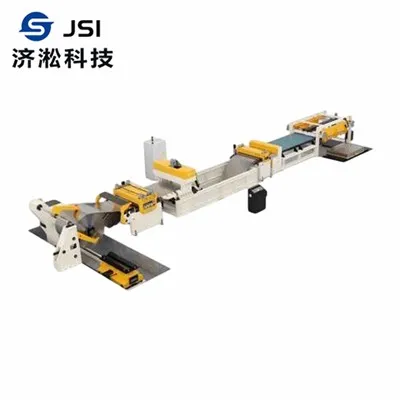
In the world of metal processing, cut to length lines play a crucial role in transforming coiled metal into precise, flat sheets of desired lengths. As a reputable supplier of cut to length lines, I've witnessed firsthand the significance of each component within these systems. One such component that stands out for its importance is the encoder. In this blog, I'll delve into the role of the encoder in a cut to length line, exploring its functions, benefits, and how it contributes to the overall efficiency and accuracy of the cutting process.
Understanding the Basics of a Cut to Length Line
Before we dive into the role of the encoder, let's briefly understand what a cut to length line is. A cut to length line is a sophisticated machine used to process coiled metal materials, such as steel, aluminum, and copper. The process typically begins with a coil of metal being loaded onto an uncoiler. The metal strip is then fed through a series of components, including a leveler to flatten the strip, a feeder to control the movement of the strip, and finally, a shear to cut the strip into the desired lengths.
What is an Encoder?
An encoder is a device that converts mechanical motion into an electrical signal. In the context of a cut to length line, the encoder is used to measure the length of the metal strip as it moves through the system. It provides accurate feedback on the position, speed, and distance traveled by the strip, which is essential for controlling the cutting process.
The Role of the Encoder in a Cut to Length Line
1. Length Measurement and Control
One of the primary functions of the encoder in a cut to length line is to measure the length of the metal strip accurately. By providing real - time feedback on the distance traveled by the strip, the encoder allows the control system to determine precisely when to activate the shear. This ensures that each cut sheet is of the exact length specified by the operator. For example, if a customer requires sheets of 2 meters in length, the encoder will measure the movement of the strip, and when it reaches 2 meters, it will send a signal to the shear to make the cut. This high level of accuracy is crucial in industries such as automotive, construction, and appliance manufacturing, where precise dimensions are required for the final product.
2. Speed Regulation
The encoder also plays a vital role in regulating the speed of the metal strip as it moves through the cut to length line. By measuring the rotational speed of the drive rollers or other moving components, the encoder provides feedback to the control system, which can then adjust the motor speed accordingly. This helps to maintain a consistent and optimal speed throughout the cutting process. For instance, if the strip is moving too fast, the encoder will detect this and the control system can slow down the motor to prevent over - cutting or uneven cuts. On the other hand, if the speed is too slow, the system can increase the motor speed to improve productivity.
3. Synchronization
In a cut to length line, multiple components need to work in harmony to ensure smooth and efficient operation. The encoder helps to synchronize the movement of different parts of the system, such as the uncoiler, leveler, feeder, and shear. By providing accurate position and speed information, the encoder enables the control system to coordinate the actions of these components. For example, when the strip is being fed through the feeder, the encoder will ensure that the feeder moves at the same speed as the strip, preventing any slipping or misalignment. This synchronization is essential for producing high - quality cut sheets.
Benefits of Using an Encoder in a Cut to Length Line
1. High Precision
The use of an encoder significantly improves the precision of the cutting process. With its ability to measure length and speed accurately, the encoder ensures that each cut sheet meets the exact specifications. This reduces waste and rework, as there is less chance of producing sheets that are too long or too short. In industries where tight tolerances are required, such as aerospace and electronics, the high precision provided by the encoder is invaluable.
2. Increased Productivity
By regulating the speed and synchronizing the components of the cut to length line, the encoder helps to optimize the production process. A consistent and efficient speed means that more sheets can be cut in a given time frame, increasing overall productivity. Additionally, the reduced need for rework due to accurate cutting also contributes to higher productivity.
3. Improved Quality Control
The encoder plays a crucial role in quality control. By providing real - time feedback on the length and speed of the strip, it allows operators to monitor the cutting process closely. Any deviations from the desired specifications can be detected immediately, and corrective actions can be taken. This ensures that only high - quality cut sheets are produced, meeting the strict quality standards of various industries.
Types of Encoders Used in Cut to Length Lines
There are two main types of encoders commonly used in cut to length lines: incremental encoders and absolute encoders.

Incremental Encoders
Incremental encoders generate a series of pulses as the shaft rotates. The number of pulses is proportional to the distance traveled or the angle of rotation. These encoders are relatively inexpensive and simple to use. They are suitable for applications where the position needs to be measured relative to a starting point. However, they do not provide absolute position information, which means that the system needs to be initialized or homed at the start of each operation.
Absolute Encoders
Absolute encoders, on the other hand, provide a unique digital code for each position of the shaft. This means that they can directly indicate the absolute position of the shaft without the need for initialization. Absolute encoders are more accurate and reliable than incremental encoders, especially in applications where precise position information is crucial. However, they are also more expensive.
Our Cut to Length Line Offerings
As a cut to length line supplier, we offer a range of high - quality systems that incorporate advanced encoder technology. Our Coil Cut To Length Line is designed to handle various coil sizes and materials, providing efficient and accurate cutting solutions. The encoder in our coil cut to length line ensures precise length measurement and speed control, resulting in high - quality cut sheets.
We also have 1500mm Cut To Length Lines that are specifically tailored for applications requiring a 1500mm width. These lines are equipped with state - of - the - art encoders to ensure optimal performance and accuracy.
In addition, our Multi - function Cutting Line offers a versatile solution for different cutting requirements. The encoder in this line helps to synchronize the multiple functions, such as cutting, punching, and notching, ensuring smooth and efficient operation.
Conclusion
In conclusion, the encoder is an essential component in a cut to length line. Its role in length measurement, speed regulation, and synchronization is crucial for achieving high precision, increased productivity, and improved quality control. As a cut to length line supplier, we understand the importance of using high - quality encoders in our systems to provide the best possible solutions for our customers.
If you are in the market for a cut to length line or have any questions about our products and the role of the encoder, we welcome you to contact us to start a procurement discussion. Our team of experts is ready to assist you in finding the right solution for your specific needs.
References
- Smith, J. (2020). Metal Processing Technologies. London: Metal Press.
- Brown, A. (2021). Encoder Technology in Industrial Automation. New York: Automation Books.