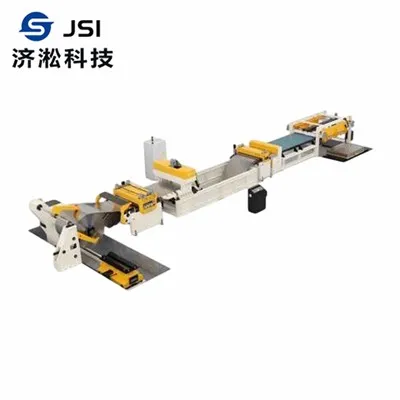
In the realm of metal processing, a steel coil slitting line stands as a crucial piece of equipment, enabling the efficient transformation of large steel coils into narrower strips. Among the various components that make up this sophisticated machinery, the decoiler plays a fundamental and often under - appreciated role. As a leading supplier of Steel Coil Slitting Line, I am well - versed in the intricacies of these systems and am eager to share insights into the role of the decoiler.
I. Basic Function of the Decoiler
At its core, the decoiler is designed to hold and unwind the steel coil at a controlled rate. A steel coil typically arrives at the slitting line in a tightly wound form, and the decoiler is the first step in the process of preparing it for further processing. It provides a stable platform for the coil, ensuring that it can be unwound smoothly without any sudden jerks or tangles.
The decoiler usually consists of a mandrel, which is a central shaft around which the steel coil is placed. The mandrel can be expanded or contracted to fit different inner diameters of the coils. This adjustability is essential as steel coils come in a wide range of sizes, and the decoiler needs to accommodate them all. Once the coil is mounted on the mandrel, the decoiler starts to rotate, gradually unwinding the steel strip.
II. Ensuring Continuous and Stable Material Supply
One of the most important roles of the decoiler is to provide a continuous and stable supply of steel strip to the rest of the slitting line. In a high - speed slitting operation, any interruption in the material flow can lead to significant production losses. The decoiler is equipped with various mechanisms to ensure that the steel strip is fed smoothly.
For example, many decoilers are equipped with a braking system. This braking system can control the rotational speed of the mandrel, preventing the coil from unwinding too quickly. It also helps to maintain tension in the steel strip. Proper tension is crucial because it ensures that the strip remains flat and straight as it enters the slitting section. If the tension is too low, the strip may sag or wrinkle, leading to uneven cuts. On the other hand, if the tension is too high, it may cause the strip to break.
Moreover, some advanced decoilers are designed with an automatic coil loading and unloading system. This system can quickly replace an empty coil with a new one, minimizing downtime and maximizing production efficiency. With this feature, the slitting line can operate continuously for long periods, meeting high - volume production requirements.
III. Compatibility with Different Types of Steel Coils
As a steel coil slitting line supplier, I understand that our customers deal with a wide variety of steel coils. These coils can differ in terms of material type, thickness, width, and weight. The decoiler needs to be able to handle all these variations.
Regarding material type, steel coils can be made of different grades of carbon steel, stainless steel, or even coated steel. The decoiler must be constructed with materials and surface treatments that are compatible with these different types of steel. For example, when dealing with stainless steel coils, the mandrel surface should be smooth and non - abrasive to prevent scratching the sensitive surface of the stainless steel.
In terms of thickness and width, the decoiler's design needs to be flexible. Thicker and wider coils require a more robust mandrel and a more powerful drive system to ensure smooth unwinding. Our company's decoilers are engineered to handle coils with a wide range of thicknesses, from thin gauge sheets used in the electronics industry to thick plates used in construction and heavy machinery.
IV. Integration with the Overall Slitting Line
The decoiler is not an isolated component but an integral part of the entire steel coil slitting line. It needs to be seamlessly integrated with other components such as the leveler, slitter, and recoiler.
The decoiler works in tandem with the leveler. Once the steel strip is unwound from the coil, it may have some residual curvature or unevenness. The leveler is responsible for flattening the strip, and the decoiler needs to supply the strip at a consistent speed and tension to ensure the leveler can perform its function effectively.


Similarly, the decoiler is also closely related to the slitter. The slitter cuts the wide steel strip into narrower strips of the desired width. The decoiler must provide a stable and accurately positioned strip to the slitter. Any misalignment or variation in the feed rate can lead to inaccurate cuts or damage to the slitting blades.
V. Role in Quality Control
The decoiler also plays a role in quality control. By maintaining proper tension and a smooth unwinding process, it helps to ensure that the steel strip entering the slitting line is in good condition. Any damage or defects introduced at the decoiling stage can propagate through the entire slitting process and affect the final product quality.
For instance, if the decoiler causes scratches or dents on the steel strip during the unwinding process, these imperfections will remain on the finished narrow strips. This can be a significant issue, especially for applications where the surface finish of the steel strips is critical, such as in the automotive or appliance industries.
VI. Applications in Different Industries
The steel coil slitting lines with efficient decoilers have wide - ranging applications across various industries. In the automotive industry, slitting lines are used to produce narrow steel strips for manufacturing car body parts, engine components, and suspension systems. The decoiler ensures that the high - quality steel coils are unwound precisely, meeting the strict quality and dimensional requirements of the automotive industry.
In the construction industry, steel strips produced by slitting lines are used for roofing, siding, and structural components. The decoiler's ability to handle large and heavy coils is essential in this industry, where high - volume production is often required.
Moreover, in the electronics industry, Non - ferrous Metal Slitting Lines and Coating Material Slitting Line are also in high demand. Although these lines may deal with non - steel materials, the principle of the decoiler remains similar. It provides a stable and controlled unwinding process, which is crucial for the precision - oriented electronics manufacturing.
VII. Conclusion and Call to Action
In conclusion, the decoiler is a vital component of a steel coil slitting line. Its role in unwinding the coil, ensuring a continuous material supply, compatibility with different coils, integration with the overall line, and quality control cannot be overstated. As a supplier of high - quality steel coil slitting lines, we are committed to providing decoilers that meet the diverse needs of our customers.
If you are in the market for a steel coil slitting line or need to upgrade your existing equipment, we invite you to contact us for a detailed discussion. Our team of experts will work closely with you to understand your specific requirements and provide you with the most suitable solution. Whether you are a small - scale manufacturer or a large - scale industrial enterprise, we have the expertise and resources to meet your production needs.
References
- "Metal Processing Handbook", John Wiley & Sons, Inc.
- "Advanced Manufacturing Technology in the Steel Industry", Springer Publishing.