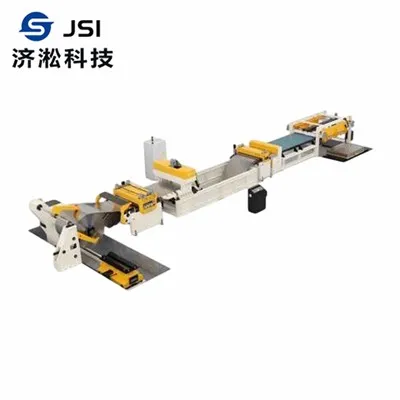
Hey there! I'm a supplier of thin sheet straighteners, and today I wanna chat about a question that often pops up: What is the minimum thickness of thin sheets that a thin sheet straightener can process?
First off, let's understand what a thin sheet straightener is all about. It's a machine designed to flatten out thin metal sheets that might have some curves, waves, or other deformities. These sheets are used in a whole bunch of industries, like automotive, electronics, and construction. You can check out some of our different types of straighteners, like the Straightener-top Flip Up, Middle Sheet Straightener, and S Type Straightener.
Now, back to the main question. The minimum thickness that a thin sheet straightener can handle depends on a few key factors.
Machine Design and Construction
The design of the straightener plays a huge role. Different models are built with different capabilities. Some straighteners are made to deal with really thin sheets, while others are more suited for slightly thicker ones. For example, a straightener with smaller diameter rolls can usually handle thinner sheets better. The rolls are what actually come into contact with the sheet and apply the force to straighten it. Smaller rolls can exert more precise pressure on thinner materials without causing damage.
Roll Material and Hardness
The material and hardness of the rolls also matter. Rolls made from high - quality, hard materials can handle thinner sheets more effectively. Harder rolls are less likely to deform under pressure, which is crucial when working with delicate, thin sheets. They can maintain their shape and provide a consistent straightening force.
Power and Torque of the Drive System
The power and torque of the drive system are important too. A more powerful drive system can provide the necessary force to straighten thin sheets. If the drive system doesn't have enough power, it might not be able to overcome the internal stresses in the sheet, especially when dealing with very thin materials.
Control System
A good control system is essential. It allows operators to adjust the straightening process precisely. With a sophisticated control system, you can set the right amount of pressure, speed, and other parameters according to the thickness of the sheet. This helps ensure that the thin sheets are straightened without being over - stressed or damaged.
Typical Minimum Thickness Ranges
In general, most thin sheet straighteners on the market can handle sheets as thin as 0.1 mm. There are some high - end, specialized straighteners that can even go down to 0.05 mm or less. But keep in mind, as the sheet gets thinner, the straightening process becomes more challenging.
For sheets around 0.1 - 0.2 mm, a well - designed straightener with the right roll configuration and control system can usually do a great job. However, when you're dealing with sheets thinner than 0.1 mm, things get a lot trickier. The sheets are extremely delicate, and even the slightest misalignment or incorrect pressure can cause them to wrinkle or tear.


Challenges with Ultra - Thin Sheets
When working with ultra - thin sheets, there are several challenges that need to be addressed.
Static Electricity
Ultra - thin sheets are more prone to static electricity. Static can cause the sheets to stick together or to the rolls, making the straightening process difficult. To deal with this, some straighteners are equipped with anti - static devices. These devices can neutralize the static charge and prevent the sheets from sticking.
Material Properties
The material properties of ultra - thin sheets can also pose challenges. Different metals have different levels of ductility and elasticity. For example, aluminum sheets are more ductile than stainless steel sheets. This means that the straightening process needs to be adjusted accordingly. If you try to straighten a thin aluminum sheet using the same settings as a stainless steel sheet, you might end up with a damaged sheet.
Handling and Feeding
Handling and feeding ultra - thin sheets into the straightener can be a real pain. The sheets are so fragile that they can easily be bent or damaged during the loading process. Specialized feeding systems are often required to ensure that the sheets are fed smoothly and evenly into the straightener.
How We Can Help
As a supplier of thin sheet straighteners, we've spent a lot of time and effort in developing machines that can handle a wide range of sheet thicknesses, including ultra - thin ones. Our straighteners are designed with the latest technology and high - quality components.
We offer a variety of models to meet different customer needs. Whether you're working with 0.1 mm sheets or even thinner ones, we have a solution for you. Our team of experts can also provide technical support and advice on the best straightening process for your specific application.
If you're in the market for a thin sheet straightener and have questions about the minimum thickness it can handle, or if you just want to learn more about our products, don't hesitate to get in touch. We're here to help you find the perfect straightening solution for your business.
Conclusion
In conclusion, the minimum thickness of thin sheets that a thin sheet straightener can process is influenced by machine design, roll material, drive system power, and control system. While most straighteners can handle sheets as thin as 0.1 mm, specialized machines can go even thinner. Working with ultra - thin sheets comes with its own set of challenges, but with the right equipment and expertise, it's definitely achievable.
If you're interested in purchasing a thin sheet straightener or want to discuss your specific requirements, reach out to us. We're ready to have a chat and help you make the best choice for your operations.
References
- "Metal Forming Handbook: Processes and Applications"
- "Rolling of Metals: Principles and Applications"