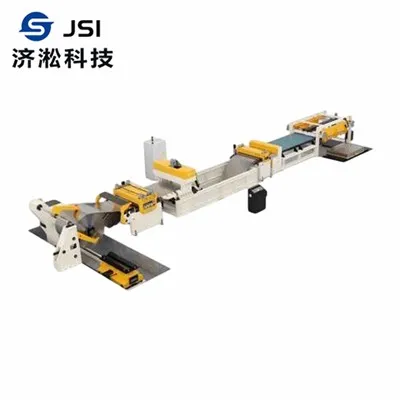
The cutting pressure plays a crucial role in the performance of a Coil Cut To Length Line. As a seasoned supplier of Coil Cut To Length Lines, I have witnessed firsthand the significant influence that cutting pressure exerts on the overall cutting quality. In this blog, we will delve into the various aspects of how cutting pressure affects the cutting quality of a Coil Cut To Length Line.
Understanding Cutting Pressure in Coil Cut To Length Lines
Before we explore its influence on cutting quality, it's essential to understand what cutting pressure is in the context of a Coil Cut To Length Line. Cutting pressure refers to the force applied during the cutting process to sever the metal coil into desired lengths. This force is generated by the cutting mechanism, which can vary depending on the type of Coil Cut To Length Line. For instance, in a Hydraulic Metal Sheet Shearing Machine, the hydraulic system provides the necessary force to drive the cutting blade through the metal.
Impact on Edge Quality
One of the most noticeable effects of cutting pressure on cutting quality is its impact on the edge quality of the cut metal sheets. When the cutting pressure is too low, the blade may not be able to fully penetrate the metal, resulting in a rough and uneven cut edge. This can lead to burrs, which are small, sharp projections on the cut edge. Burrs not only affect the aesthetic appearance of the metal sheets but also pose a safety hazard during handling and further processing.
On the other hand, excessive cutting pressure can cause the metal to deform plastically around the cut edge. This plastic deformation can lead to a phenomenon known as rollover, where the edge of the metal curls over. Rollover can reduce the dimensional accuracy of the cut sheets and may also affect the fit and function of the final product. Therefore, finding the optimal cutting pressure is crucial to achieving a clean, smooth, and burr - free cut edge.
Influence on Dimensional Accuracy
Dimensional accuracy is another critical aspect of cutting quality in a Coil Cut To Length Line. Cutting pressure can have a direct impact on the length and width of the cut metal sheets. If the cutting pressure is inconsistent across the width of the coil, it can cause the sheet to warp or bend during the cutting process. This warping can result in variations in the length and width of the cut sheets, leading to dimensional inaccuracies.
Moreover, excessive cutting pressure can cause the metal to compress or stretch locally, which can also affect the dimensional stability of the cut sheets. For example, if the pressure is too high at the center of the cut, the metal may be compressed, resulting in a shorter length than the desired specification. To ensure high - dimensional accuracy, it is necessary to maintain a uniform and appropriate cutting pressure throughout the cutting process.
Effect on Tool Life
The cutting pressure also has a significant influence on the life of the cutting tools in a Coil Cut To Length Line. When the cutting pressure is too high, the cutting tool is subjected to excessive stress, which can cause premature wear and tear. The increased stress can lead to chipping, cracking, or even breakage of the cutting blade. This not only increases the cost of tool replacement but also disrupts the production process.
Conversely, if the cutting pressure is too low, the blade may have to work harder to cut through the metal, which can also accelerate wear. The blade may experience more friction and heat generation, leading to a shorter tool life. Therefore, by optimizing the cutting pressure, we can extend the life of the cutting tools, reduce maintenance costs, and improve the overall efficiency of the Coil Cut To Length Line.
Role in Material Type and Thickness
The influence of cutting pressure on cutting quality is also closely related to the type and thickness of the metal material being cut. Different metals have different mechanical properties, such as hardness, ductility, and toughness. Harder metals generally require higher cutting pressures to achieve a clean cut, while softer metals may require lower pressures to avoid deformation.
For example, when cutting stainless steel, which is a relatively hard material, a higher cutting pressure is needed to overcome its strength. In contrast, when cutting aluminum, a softer metal, excessive pressure can cause the metal to smear or deform. Similarly, the thickness of the metal also affects the required cutting pressure. Thicker metal sheets require more force to cut through compared to thinner ones. Therefore, it is essential to adjust the cutting pressure according to the specific material type and thickness to ensure optimal cutting quality.
Optimizing Cutting Pressure for Better Quality
As a Coil Cut To Length Line supplier, we understand the importance of optimizing cutting pressure to achieve the best cutting quality. Our Multi - function Cutting Line and Fully Automatic Cutting Machine Production Line are equipped with advanced control systems that allow for precise adjustment of the cutting pressure.
These control systems can monitor and adjust the cutting pressure in real - time based on various factors, such as the material type, thickness, and cutting speed. By using these advanced technologies, we can ensure that the cutting pressure is always within the optimal range, resulting in high - quality cut metal sheets.


Conclusion
In conclusion, the cutting pressure has a profound influence on the cutting quality of a Coil Cut To Length Line. It affects the edge quality, dimensional accuracy, tool life, and is closely related to the material type and thickness. As a supplier, we are committed to providing our customers with cutting - edge solutions that can optimize the cutting pressure and deliver superior cutting quality.
If you are in the market for a Coil Cut To Length Line or have any questions about cutting pressure and its impact on cutting quality, we invite you to contact us for a detailed discussion. Our team of experts is ready to assist you in finding the best solution for your specific needs.
References
- Smith, J. (2018). Metal Cutting Technology. Publisher X.
- Johnson, M. (2019). Advances in Coil Processing. Publisher Y.
- Brown, A. (2020). Cutting Pressure Optimization in Industrial Cutting Processes. Publisher Z.