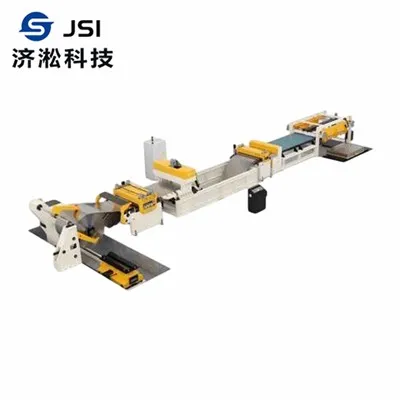
A blanking line is a crucial piece of equipment in the metalworking industry, designed to transform continuous coils of metal into individual, precisely cut blanks. As a seasoned blanking line supplier, I've had the privilege of working with various types of blanking lines and understanding their intricate components. In this blog, I'll delve into the key components that make up a blanking line, shedding light on their functions and importance.
Uncoiler
The uncoiler is the starting point of the blanking line. Its primary function is to hold and unwind the metal coil. There are different types of uncoilers, including mechanical, hydraulic, and pneumatic ones. Mechanical uncoilers are often used for lighter coils, while hydraulic uncoilers are more suitable for heavier and larger coils. The uncoiler is equipped with a mandrel that expands to grip the inner diameter of the coil. As the line operates, the uncoiler rotates, gradually feeding the metal strip into the next stage of the process.
Straightener
Once the metal strip is unwound from the coil, it often has some degree of curvature and unevenness. The straightener is responsible for flattening the strip and removing any residual stresses. It consists of a series of rollers arranged in an alternating pattern. As the metal strip passes through these rollers, the rollers apply pressure to bend and straighten the strip. The number and size of the rollers can vary depending on the thickness and width of the metal strip. A well - functioning straightener ensures that the subsequent cutting process is more accurate and the final blanks are of high quality.


Feeder
The feeder is a critical component that precisely controls the movement of the metal strip through the blanking line. It measures and feeds the strip forward in a consistent and accurate manner. There are different types of feeders, such as mechanical feeders, servo - driven feeders, and roller feeders. Mechanical feeders are relatively simple and cost - effective, but they may have limitations in terms of accuracy and speed. Servo - driven feeders, on the other hand, offer high precision and can be easily programmed to adjust the feed length and speed according to the requirements of the blanking process. Roller feeders use a pair of rollers to grip and move the metal strip, providing a smooth and reliable feeding operation.
Blanking Press
The blanking press is the heart of the blanking line. It is responsible for cutting the metal strip into individual blanks according to the desired shape and size. There are two main types of blanking presses: mechanical presses and hydraulic presses. Mechanical presses use a flywheel and a crankshaft mechanism to generate the force required for cutting. They are known for their high - speed operation and are suitable for mass - production applications. Hydraulic presses, on the other hand, use hydraulic cylinders to generate force. They offer more flexibility in terms of force control and can be used for cutting thicker and harder metals. The blanking press is equipped with a die set, which is a custom - made tool that determines the shape of the blanks. The die set consists of a punch and a die, and when the press operates, the punch descends into the die, cutting the metal strip.
Scrap Handling System
During the blanking process, a significant amount of scrap metal is generated. The scrap handling system is designed to collect and remove this scrap from the work area. It typically includes a conveyor system that transports the scrap to a collection bin or a recycling area. Some advanced scrap handling systems can also separate different types of scrap, such as small pieces and large pieces, for more efficient recycling. A well - designed scrap handling system not only keeps the work area clean and safe but also helps to reduce waste and improve the overall efficiency of the blanking line.
Stacker
After the blanks are cut, they need to be stacked neatly for further processing or storage. The stacker is responsible for this task. It can be a simple manual stacker or an automated stacker. Automated stackers use sensors and robotic arms to pick up the blanks and stack them in a precise and organized manner. They can be programmed to stack the blanks in different patterns and arrangements, depending on the customer's requirements. A good stacker ensures that the blanks are protected from damage during the stacking process and are easy to handle and transport.
Control System
The control system is the brain of the blanking line. It coordinates the operation of all the components and ensures that the entire process runs smoothly. Modern control systems are often based on programmable logic controllers (PLCs) and human - machine interfaces (HMIs). The PLCs are used to control the movement, speed, and timing of each component, while the HMIs provide an intuitive interface for operators to monitor and adjust the parameters of the blanking line. The control system can also be integrated with other systems, such as quality control systems and production management systems, to improve the overall efficiency and quality of the blanking process.
Types of Blanking Lines
There are different types of blanking lines available in the market, each with its own unique features and applications. For example, the Laser Blanking Line uses a laser cutting system instead of a traditional blanking press. Laser cutting offers high precision and can cut complex shapes with ease. It is suitable for applications where high - quality and intricate blanks are required.
The Multi Cut Precison Blanking Line is designed to make multiple cuts simultaneously, increasing the production efficiency. It can be used for mass - producing simple - shaped blanks.
The Zigzag Blanking Line is a specialized type of blanking line that cuts the metal strip in a zigzag pattern. This type of line can optimize the use of the metal strip and reduce waste, making it more cost - effective.
Conclusion
In conclusion, a blanking line is a complex and sophisticated piece of equipment that consists of several key components. Each component plays a vital role in the overall performance and efficiency of the blanking process. As a blanking line supplier, we understand the importance of providing high - quality components and reliable systems to our customers. Whether you are looking for a standard blanking line or a customized solution, we have the expertise and experience to meet your needs.
If you are in the market for a blanking line or have any questions about our products, we encourage you to reach out to us for a detailed discussion. Our team of experts is always ready to assist you in finding the most suitable blanking line for your specific requirements.
References
- ASM Handbook Volume 14B: Metalworking: Sheet Forming. ASM International.
- Manufacturing Processes for Engineering Materials by Serope Kalpakjian and Steven Schmid.