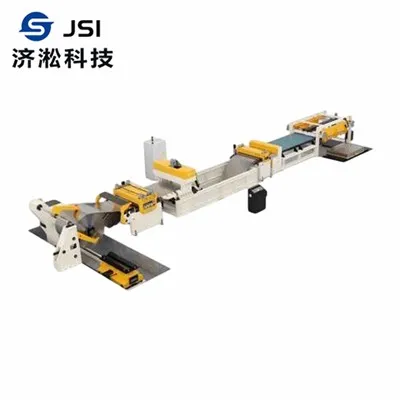
Selecting the appropriate die for a High Speed Blanking Line is a critical decision that can significantly impact the efficiency, quality, and cost - effectiveness of your manufacturing process. As a supplier of High Speed Blanking Lines High Speed Blanking Line, I've witnessed firsthand the challenges that manufacturers face when making this choice. In this blog, I'll share some key considerations and guidelines to help you make an informed decision.
Understanding the Basics of High Speed Blanking
High speed blanking is a manufacturing process used to cut flat shapes from sheet metal at high speeds. It is widely used in industries such as automotive, electronics, and appliances to produce components like washers, brackets, and electrical contacts. A High Speed Blanking Line typically consists of a coil feeder, a press, and a die. The die is the tool that actually cuts the metal into the desired shape.
Factors to Consider When Selecting a Die
1. Material Type and Thickness
The type and thickness of the material you are blanking are crucial factors in die selection. Different materials have different mechanical properties, such as hardness, ductility, and tensile strength. For example, stainless steel is harder and more difficult to cut than mild steel, so a die designed for stainless steel will need to be made of a more wear - resistant material.
Similarly, the thickness of the material affects the cutting force required. Thicker materials require more force to cut, which means the die must be stronger and more robust. A die for thin materials may be made of a less expensive tool steel, while a die for thick materials may need to be made of a high - performance alloy.
2. Part Geometry
The shape and size of the part you are producing also play a significant role in die selection. Complex geometries with sharp corners, small holes, or intricate patterns require more precise dies. For instance, a die for a part with many small holes will need to have well - designed punches and strippers to ensure proper hole formation and prevent material deformation.


The size of the part affects the die's overall dimensions and the number of cavities that can be included. Larger parts may require a larger die, which can increase the cost. However, if you need to produce a large volume of parts, a multi - cavity die may be more cost - effective in the long run.
3. Production Volume
The production volume is another important consideration. If you are producing a small number of parts, a simple, single - cavity die may be sufficient. These dies are generally less expensive to manufacture and can be produced quickly.
On the other hand, if you are producing a large volume of parts, a multi - cavity die or a progressive die may be more appropriate. A multi - cavity die has multiple identical cavities, allowing you to produce multiple parts in a single stroke of the press. A progressive die is a more complex die that performs multiple operations, such as cutting, bending, and forming, in a single pass through the die. These dies are more expensive to design and manufacture but can significantly increase production efficiency.
4. Production Speed
High Speed Blanking Lines are designed to operate at very high speeds, so the die must be able to withstand the high - speed cutting forces and rapid cycling. A die that is not designed for high - speed operation may wear out quickly, leading to frequent die changes and increased downtime.
To ensure high - speed performance, the die should have proper lubrication and cooling systems. Lubrication reduces friction between the die and the material, which helps to extend the die's life and improve the quality of the cut. Cooling systems can prevent the die from overheating, which can cause thermal expansion and affect the die's accuracy.
5. Quality Requirements
The quality requirements of the parts you are producing are also important. If you need parts with high dimensional accuracy and surface finish, you will need a high - precision die. High - precision dies are typically made with tight tolerances and advanced manufacturing techniques, such as wire EDM (Electrical Discharge Machining).
In addition, if the parts require a high level of repeatability, the die must be designed to maintain its accuracy over a long period of use. This may involve using high - quality materials, proper heat treatment, and regular maintenance.
Different Types of Dies for High Speed Blanking Lines
1. Single - Operation Dies
Single - operation dies are the simplest type of dies. They perform only one operation, such as cutting or punching. These dies are often used for low - volume production or for parts with simple geometries. They are relatively inexpensive to manufacture and easy to maintain.
2. Multi - Cavity Dies
Multi - cavity dies have multiple identical cavities, allowing for the production of multiple parts in a single stroke of the press. These dies are suitable for high - volume production of small to medium - sized parts. By increasing the number of parts produced per stroke, multi - cavity dies can significantly improve production efficiency.
3. Progressive Dies
Progressive dies are more complex dies that perform multiple operations, such as cutting, bending, and forming, in a single pass through the die. The strip of material moves through the die in a progressive manner, with each station performing a different operation. Progressive dies are ideal for high - volume production of complex parts, as they can reduce the number of handling steps and improve part quality.
4. 3 in 1 Blanking Line Dies
3 in 1 Blanking Line dies are designed for a specific type of blanking line that combines a decoiler, a straightener, and a feeder into one unit. These dies are often used for applications where space is limited or where a compact and efficient blanking solution is required.
5. Multi Cut Precision Blanking Line Dies
Multi Cut Precision Blanking Line dies are used for high - precision blanking applications. These dies are capable of producing parts with very tight tolerances and excellent surface finish. They are often used in industries such as electronics and medical devices, where precision is critical.
Working with a Die Manufacturer
Selecting the right die for your High Speed Blanking Line can be a complex process. It is often beneficial to work with an experienced die manufacturer. A good die manufacturer will have the expertise and resources to design and manufacture a die that meets your specific requirements.
When choosing a die manufacturer, look for one with a proven track record in high - speed blanking. They should be able to provide you with samples of their previous work, as well as references from satisfied customers. Additionally, the manufacturer should be able to offer technical support and after - sales service, such as die maintenance and repair.
Conclusion
Selecting the appropriate die for a High Speed Blanking Line is a decision that requires careful consideration of multiple factors, including material type, part geometry, production volume, production speed, and quality requirements. By understanding these factors and working with an experienced die manufacturer, you can ensure that you choose a die that will meet your production needs and provide you with a high - quality, cost - effective solution.
If you are in the market for a High Speed Blanking Line or need assistance with die selection, we are here to help. Our team of experts has extensive experience in high - speed blanking and can provide you with the guidance and support you need to make the right decision. Contact us today to start a discussion about your specific requirements and explore how we can work together to optimize your manufacturing process.
References
- Tool and Die Design Handbook, Second Edition by George E. Dieter
- Metal Forming: Mechanics and Metallurgy by Dieter, G.E.
- High - Speed Blanking Technology: Principles and Applications by Industry Research Group